



SwRI built a private, secure, high-velocity 5G network to advance wireless research and development, now and in the future. The versatile network operates on campus with fixed infrastructure or in the field with mobile components without relying on traditional mobile network providers. It currently supports 5G projects in cybersecurity, drone technology, edge computing and more, but it is ready to take on 6G and beyond. Future G capabilities will include artificial intelligence, satellite, virtual reality and holographic technology.
Listen now as SwRI RF Sensors and Systems Department Director and 5G expert Jody Little discusses the benefits of a private 5G network, SwRI R&D progress using this new tool and the possibilities of Future G technology.
Visit Advanced Systems to learn about SwRI’s wireless communications capabilities.
Transcript
Below is a transcript of the episode, modified for clarity.
Lisa Peña: SwRI's new private, secure, high-velocity, 5G network allows rapid communication and connection anywhere. The wireless network is advancing 5G research and development, and it's built for the future. We'll tell you about the advanced projects powered by private 5G and what's possible with future G technologies. That's next on this episode of Technology Today.
[MUSIC PLAYING]
We live with technology, science, engineering, and the results of innovative research every day. Now, let's understand it better. You're listening to the Technology Today Podcast presented by Southwest Research Institute. From deep sea to deep space, we develop solutions to benefit humankind. Transcript and photos for this episode and all episodes are available at podcast.swri.org. Share the podcast and hit that subscribe button on your favorite podcast platform.
Hello and welcome to Technology Today. I'm Lisa Peña. SwRI installed a powerful new tool to advance 5G research and development, a private 5G research, development, test, and evaluation network. The infrastructure is located on campus, but the system is mobile and can be transported anywhere to provide rapid communication and connection. And it's built for future G progress. We're talking about 6G and beyond.
SwRI Director of Research and Development and our in-house 5G expert Jody Little is overseeing network installation and development. This is his second time as a podcast guest. So thank you for joining us again, Jody, for a 5G update. It's great to have you back.
Image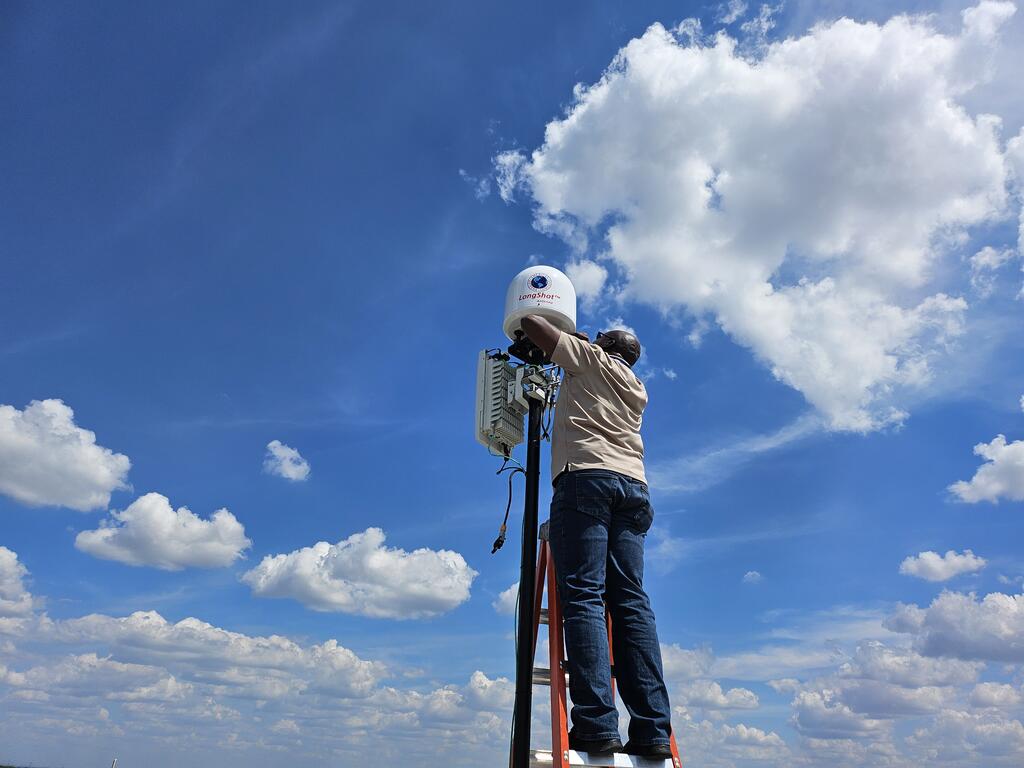
SwRI installed a private, secure, high-velocity 5G network available for Institute research and development. The network operates with infrastructure on campus or in the field with mobile equipment. Pictured here, an SwRI network systems manager mounts an antenna to extend private 5G coverage range.
Jody Little: Thank you, Lisa. It's great to be here, too, and I appreciate you having me on the podcast again.
LP: I'm so happy you're here. And I want to start with an overview of 5G wireless technology. So let's recap for our listeners. How does it work? Why is 5G a powerful way to connect?
JL: So 5G is a leapfrog from what we're used to in the 4G world, LTE world, and it brings in new technologies with new specifications driving those technologies, for example, much lower latency, enhanced spectrum efficiency, so it's a better use of the spectrum. Also massive connectivity, so you have many more connections through one of the cells that are there. And then within that, it's much more efficient in the data transfer, higher speed data transfers, and so on.
So they also add a concept of network slicing, which allows the network to be divided up, much like a software-defined network is, so that you can have multiple segmented communications capabilities going.
LP: OK, so 5G giving us an advanced superior connection. And I just want to remind listeners, 5G is short for fifth generation, so it's the fifth generation of this technology.
JL: So that's an interesting thought. It is the fifth generation. The tradition has been across, is that the odd numbers are leapfrog. They bring significant technology in where the even numbers will bring you a graduated increase of efficiency and technology.
So for example, we would see 4G to 5G is a big change in technology and architecture. But from 5G to 6G there'll be a more of a gradual transition. You'll see 5G transitioning into the 6G future. We'll see what 7G brings.
LP: All right, so I am excited to talk about the future and 6G and beyond coming up in a moment. But I want to get into our private 5G network. And so let's start with what is a private 5G network? What are the benefits of going private with 5G.
JL: So one of the big benefits is that we control the whole network. It's private to Southwest Research Institute. And we control who has access, what communicates over it, and don't have to compete with other users outside of our Institute. So it's so a self-contained, if you will.
The other one is we have some enhanced security there involved to keep it out. The biggest thing that we get out of it is some guaranteed performance. But in reality, we can manipulate that private 5G network on our campus to support various research, development, testing, evaluation projects, whether they're internal or external research.
LP: OK, so what are some situations when a private 5G network, like the one installed here at SwRI, is a better option than relying on, let's say, a commercial mobile provider?
JL: Well, one of the first ones is in terms of research and development, which we do at the Institute. It allows us to control the configuration and what devices or hardware is installed, what software is running, and we can split that out to cover different projects simultaneously.
We've also built a network so we can take it mobile, different locations. So should we have something that's in a field offsite, we can take it there and set up a private 5G network for that particular set of projects that are going on at that field site.
LP: And I know we've touched on this before in our off-mic conversations, but there are a lot of industries and organizations that would benefit from a private 5G network and situations where they come in handy. Can you talk to us a little bit about that?
JL: I can, and we're seeing a lot of private 5G networks pop up, both in the military side and defense side, as well as in industry. Typically, mission-critical operations is one of the places you're seeing it.
So if you look at scale operations, say, a factory floor, where they're using many different IoT or devices that have to be interconnected. We've seen 5G starting to take over instead of the traditional IT.
We've also seen using private 5G in challenging environments, so RF environment, Radio Frequency environments, where they can control what RF being used on the site. And also that includes not having to compete with, in our case, with the mobile network operators. So we work within the citizens band radio service, which gives us an unlicensed capability, but we can bring up and run there without having to pay or interact with the MNOs.
Military operations is a real good example, and we're doing a lot of work with the military right now, supporting mobile tactical operations and the concept of connectivity bubbles so that the network moves with the military is connected through other backhaul, whether that satellite, other communications, RF, or through, say, for instance, other 5G networks that are in the area they're working. So we can bring that data and they can continue to operate with massive connectivity in operations.
LP: But let's talk about a case of severe weather. Hurricane hits and knocks out all communication or other severe weather tropical systems.
JL: This actually is a problem in the Caribbean and also in the Pacific. So we've worked with the US Virgin Islands on setting up and defining what a 5G network private network would do for them. They have a problem. When the hurricanes come across, it tends to wipe out their communications.
The mobile network operator that operates down there tries to get this back up, but it takes weeks sometimes. They need instantaneous. So as soon as the hurricane subsides, they want to be out there and communicating, supporting recovery operations. And by putting a mobile 5G capability there, they can go out and set that up as soon as the winds die down and start communicating in the areas they need.
We've also connected VHF and UHF radios to it, which means they can bring those radios inside the 5G network for conference calls, or they can be on a phone talking to a aircraft or to a helicopter that's bringing in supplies, for instance. So that's a big aid in terms of emergency operations.
LP: Yeah, great example there of critical use for this type of system. And one more example I know you've discussed recently, is oil field workers.
JL: So just like in the emergency operations, if you're out in the field, say for instance, Central to South Texas where the oil fields are down there, they don't have a lot of 5G connectivity, or 4G for that matter, especially when they get in some of the big areas where they're doing the wells.
So what's happening is they're putting 5G, mobile 5G systems down. They're setting them up temporarily, supports communications among the wells. They can also connect the 5G to the IoT devices, such as your SCADA controllers on their wells and communicate with those. But when they finish and move to the next one, they can move that particular mobile 5G network with them to do that, so it really supports that. They can also have multiple 5G capabilities across a large oilfield area and connect those together until they need to move them.
LP: All right, so many uses for private mobile 5G networks. Let's talk about the security of it. How does a private network remain secure?
Image
This hardware runs the HPE 5G Core, the anchor for SwRI's Private 5G RDT&E Network. The core software stack implements the primary 5G standalone network functions, managing all user equipment authentication, session policies and user plane traffic breakout to external data networks. The network is available to both internal and external research partners.
JL: So one of the specifications, and a lot of thought, went into how do we make 5G secure? So the 3GPP, which is the governing body that set the standards and it's an international body, set the standards. They put a lot of work into the security of the communications.
Obviously, in this day and age, that is a major factor in a lot of things we do communicate, transfer data. So 5G security has various aspects. For instance, you can do network isolation in a 5G, so on. Inherent 5G security is robust. It's built into it at different levels to cover the encryption and over-the-air transmissions.
The other one is slicing, and I mentioned that before, I believe. Slicing allows us to break up the band and put in a software-defined type of network goes all the way across the RF to the UE, to User Equipment. And what that allows us to do is put different levels of encryption and isolate various capabilities.
So you can imagine it has some critical operations, whether that's financial or military command and control, versus logistics operations, versus recovery operations, or just some nominal other operations. I can break those out into different slices or channels and allow the communications to go at different security levels.
And also, 5G was built with the idea of zero-trust architecture in mind, using the zero-trust security model, which is a framework being pushed by NIST and others to verify users as they come on critically to the system and regardless of location where they are. So zero trust is a big deal, both in the 5G but also in the computer world and the communications world.
LP: We do have a Technology Today episode about zero-trust technology in vehicles.
JL: That's right.
LP: So nerds can refer to that. Getting into the Southwest Research Institute applications for the private 5G network, why did SwRI invest in the infrastructure and install this private 5G network? How are we using it?
JL: Well, so the primary purpose of putting 5G on the network was because we didn't have a large communications infrastructure. We had small, isolated comms supporting different projects and different clients, but nothing that would allow us to do 5G, big 5G type of capability.
So when we looked at it, things like autonomous vehicles and intelligent network traffic management were two of them. There was also on the side of our defense side, where we do a lot of communications security and things, the 5G allows us to support that. It's also tying into space capabilities where you can bring non-terrestrial into the networks both in the current one, but also in the future generations.
So there were a lot of potential applications. In the RF side, working with the future Radio Access Network, or they call it RAN, O-RAN, Open RAN is will allow us to bring in things such as AI and machine learning to support spectrum management and other activities or cybersecurity at the same time. So there's a lot of research opportunities in the 5G and moving into the 6G realm.
The other one was because 5G, and it's already seen happening in the community. In the country is, 5G is becoming the new IT, if you will. And you see that because you see people putting in 5G modems for their internet connectivity, and so that they have all their internet access, their video to watch TV and so on is going through this mobile network operator 5G device.
LP: And that's instead of fiber.
JL: Instead of fiber. They've dropped their fiber. For the providers, it's cheaper because there's less hardware for them, and it works within their network. They are pushing the bandwidth limitations, but they're expanding them almost as fast as they can get the devices out.
So we're seeing that happen in some businesses, as well. Rather than running a lot of hard wire, they'll put in multiple private 5G, smaller things, in their operations, whether it's a factory or an office floor. Connect their devices through that 5G but control it within their private network. And so you're going to see this expand across the country over the next five or six years. A lot of private 5G popping up.
LP: OK, so here at SwRI, we do as we like to say, our research and development spans deep sea to deep space, everything in between. So this private network, this private 5G network has the potential to benefit all areas of research, many areas of research that we conduct here. But it's also great news for our clients. So if our clients have 5G needs, come over, see what we can do for you.
JL: So our clients, especially on the government side, are still learning where they can use and how to use 5G and work it into their future architectures. On the industry side, pretty much the same.
One of the areas that's untapped, as of yet, at Southwest Research Institute is the use of 5G to support applications. So I think we're going to see that start in the near future, where clients will want to have interconnectivity and they have their applications running within a 5G private network and to be able to support that information transfer and so on.
Whether it's a private 5G network or it can reach out through the other 5G, commercial 5G operations will be important. I think if you talk about the oil field, for example, connecting to 5G is one thing but also providing applications that will allow them to monitor what's happening in the 5G or in their specific application they're doing so like monitoring the oil wells efficiency, monitoring how the pumping is going, how the trucks are moving, and so on. So I think there's a application side that we have untapped yet that we feel our clients will want.
LP: Are you talking about apps on your phone where you.
JL: Yeah.
LP: Yeah, so you've given us some really great examples of how the private 5G network benefits our research and development. But let's get into some specific projects. What type of R&D are we conducting using this private 5G network? I know we've touched or we've talked about drone technology, edge computing. Where does this take us?
JL: So you got to realize the 5G network on Southwest Research has been in an initial operating capability since pretty much mid to end of August. So it's fairly new. We've already done work in the cybersecurity side, both pentesting as well as looking at it.
We're actually working up to support research in the quantum resilience field over a 5G ecosystem, which is quantum encryption and the resilience that's required to manage the keys across that in a distributed environment. In the RF side, we've done anti-jamming.
So jamming obviously, to the military side, is a big issue with 5G. How can I prevent jamming? So we've worked with some industry partners to support anti-jamming. And we have various clients, including the Office of Secretary of War. Their 5G cross-functional team is wanting us to go out to Fort Polk and demonstrate and do an experiment with the anti-jamming.
The other areas, we've been working, some drone connectivity, so connecting drones. So we have one client, which I'm not going to go into details about, that want to connect up to about 300 drones and support. They call them swarms, and you could consider that, but it's more like 300 collaborative drones supporting training for the military. So we're working down those paths.
And we've got other various activities. We actually have connected a couple other military applications to support AES 256 encryption across, which is a very good encryption used by the DOD and the feds and others to encrypt their communications. But we're pushing that across the 5G from various devices for information exploitation. And then finally, we're looking at from a cyber standpoint. We've done quite a bit of cyber, both defense and offense side of cyber.
LP: So I mentioned edge computing.
JL: So edge computing is pushing and that's actually a really important part of the 5G and future G. Doing edge computing, you're computing right up near the 5G Open RAN connectivity so that you get low latency.
So the connectivity between devices, user devices and the O-RAN is fairly fast. It's where you learn in the lag is across the backhaul. So if you're communicating with the cloud, it can be substantially longer. If I move my computing right there next to it, I get significant increase in performance and capability and communications. That latency goes way down.
We've done experiments in the past where we've had it down below 20 milliseconds, which is getting into real time. And what that means is things like virtual reality. Right now, they have to cache polygons and push them out to keep up to real time for virtual reality. Well, now I can generate those at the edge in near real time and real time and have them sent to the device in less than 20 milliseconds, which is huge.
The other side, we look at the 5G computing, if you look on the mobile and tactical computing is to be able to push data and keep that data local so that if you lose your backhaul, you still have the ability to operate in that bubble. And that's another big area that we've been working on, the edge computing, which is a little different, but it still relies on edge computing.
LP: All right, so it sounds like the private 5G network hit the ground running. It's in high demand, it sounds like.
JL: I'd like to add that we're open to bringing other. We built this to design to support multiple research and development projects simultaneously on this network, whether that's on campus or whether we take that off campus to field sites.
LP: Well, that takes us nicely to my next question. Because I want to learn more about how private 5G operates. You have touched on it a little bit. But yeah, you're not dependent on a mobile network provider. So tell us about the architecture and the versatility of the system.
Image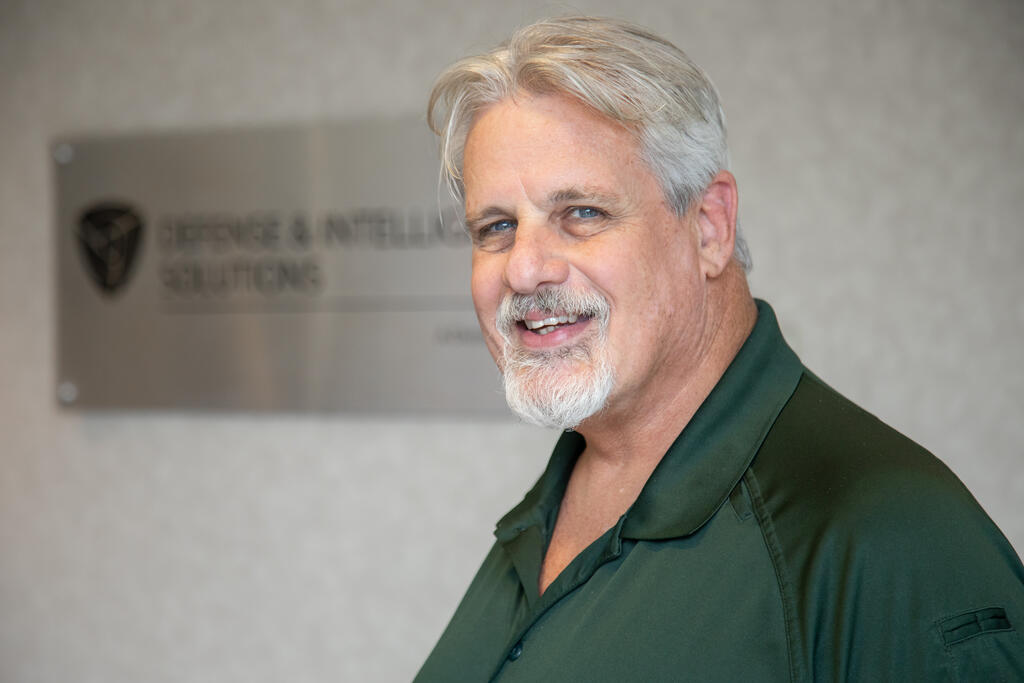
SwRI Director of Research and Development and 5G expert Jody Little led SwRI’s private 5G network development and installation.
JL: So the architecture on campus is, we have the campus covered from the top of six cells atop two of the buildings, and they cover 95% of the campus. There is one area, way at the far end, that's low that that's actually still wooded, that's not covered. But we can connect to from any of those points across the campus, putting them inside the private 5G network.
Within that, we can run different experiments or different capabilities. We also have the capability to stand up other 5G cores or 5G O-RAN, open radio access networks, to support various different kinds of experiments. So if we have to isolate from the campus network, we can certainly do that. And we have done that. We've taken some of them into the anechoic chambers, for example, to test the RF and evaluate the RF capability of some of the things we were doing.
It also was built that way to support changing out cores, so we can run multiple cores. We can also run multiple O-RANs. So if we want to bring in a new 6G or future G type of component, it's built to support that and do testing and evaluation on those devices.
LP: So I get that the infrastructure is here on campus, and the network works seamlessly on campus, but you can take it off campus. So how does that work?
JL: So if you think about some of the research that we do at Southwest Research Institute, some of it's field based. And if you look at things like the autonomous vehicles, where they may take them out to a test track, whether it's supporting clients or to support other capabilities, they'll be able to take a complete 5G network and set it up in less than 30 minutes, likely to support connectivity, assuming it's been pre-setup for their project.
We can take that out into the field. We have taken it out in the field at least three or four times since July, where we've supported some military capabilities where they were looking to connect and disseminate certain kinds of data.
We've also done that by encrypting the data at both ends, so they could push classified data across those networks. And those were based on the mobile networks we've set up.
LP: So when you do take it off campus, is it connected to a satellite, or how does it work?
JL: So it depends. It depends on what you need for your application. We can set it up so it's isolated. It doesn't have backhaul, and you're using just an edge computing to support your data you need.
But we also have Starlink capability with ability to connect up to three or four different Starlink satellites to it so that we can transfer. And we found that works extremely well. And it also, coincidentally, ties to the military, where we've used some of this to their Star Shield capability. So we're getting this pretty close to same level of performance, and it readily supports the backhaul we need to communicate.
We also have worked with some of the other client commands, as well as, I mentioned earlier, the Virgin Islands, about how they would use this in the backhaul over satellite to support the emergency operations, where they can bring, say, for instance, our north that does the US, North America support for operations like that, emergency operations, military operations, how they would bring them in and be able to provide real-time connectivity to that through a 5G if they lost other communications.
LP: OK, the network operates on the citizens broadband radio service spectrum. Tell us more about this spectrum.
JL: Right now, we're all used to going to our mobile network operators and paying for use of spectrum. The government set aside a series of bands they call citizens band, citizens broadband radio service, which basically is unlicensed.
And so it runs between 3.55 and 3.7 gigahertz, and anybody can use that. It's a government-authorized access. So you do register, you do get permission to use it, but you don't have to buy a license.
And they also call it the innovation band because it's a lower barrier. We can do the experiments we need on campus without having to get permission or get limitations from other MNOs, or Mobile Network Operators, we might have to work with on that.
We can pretty much use where we need to be in this spectrum. We can change out how we're connecting across the frequency band in a CBRS, as well. So it's very conducive to our ability to do R&D.
LP: Looking ahead, the network will support future G technologies, as you've mentioned. So future G, we're talking about 6G and beyond. So what new capabilities are we talking about with future G? What's possible with future G?
JL: So we'll say 6G, and then future is 6G and beyond. It's still being defined. But there are some things that have been said. One of those is AI native networks. The movement AI and machine learning into the ecosystem, for example, within the Open RAN, radio access networks, putting AI, machine learning support, intelligence spectrum management. And that has the capability to allow you to even have more communications with higher quality of service within those networks and that RF that they're talking.
Also, in a similar sense, is cybersecurity at the front end to be able to look at data coming off the network before it even goes back into the edge or the backhaul, to do cybersecurity to see what's happening. And things like the interference we talked about, or anti-jamming we talked about earlier, that's happening at the O-RAN level. So that capability, although it's now in 5G, would become an inherent capability, for example, in 6G and then carry beyond.
Other capabilities include putting AI machine learning at the core level, so you have intelligent core. Again, cybersecurity and optimization are the two big areas. They actually open up the spectrum, and we actually look at, in the future, and 6G We'll start with terahertz communications, so that's pretty significant jump in frequencies.
You'll see that moving towards the satellite communications area or line of sight. And that will move a massive amount of data, will allow a mass amount of data. We're just starting to get into terahertz communications at Southwest Research. But I think we'll continue growing in that area because of our communications, our space operations, as well as our defense operations that we do where those become relevant.
Then the final one is full-spectrum operations. So you have non-terrestrial tied into 6G, and it's seamless. We're actually seeing some of that already. We work through Starlink, for example, and we make it look transparent to the end user. But in 6G and beyond, it'll completely be integrated into the ecosystem, rather than us strapping it onto the side.
LP: So what are some applications for everyday users that 6G and beyond might bring us?
JL: Well, for everyday users, one of those would be being able to do real-time gaming right on your phone with virtual reality and high-speed gaming.
LP: Oh, OK, there you go.
JL: So right now, the PS5s and the other devices are actually you could think of them as edge devices. So you're connecting through the backhaul, bringing it down, and running on them. But this will allow it to be done across the ecosystem, rather than having to have separate capability to do it. So you'll be able to connect augmented reality through it.
One of the things that they're looking at for future G and 6G, they're already doing this, but future G will have enough bandwidth and quality of service to support holographic TelePresence, which is a lot of that.
LP: Yeah.
JL: And so you've seeing that, but it takes a lot of bandwidth to do that. But the future 6G will be able to do that. And it sounds like, wow, future, but it's a pretty big deal where you can be sitting in a meeting that's somewhere else, instead of just on a screen, you're actually sitting in that meeting holographically. And there's already some demos out there on the web of that. So that's kind of growing.
Enable digital twins for entire cities. So we're actually working with some of the University-owned digital twin for 6G and have worked with UTSA and others to bring 6G digital twin to support doing research and development before we ever put a device in there.
So that allows more research to be done within that 6G digital twin, before you spend a lot of money putting a lot of infrastructure in place. So we're seeing that.
And then intelligent automation is going to be another big one. We're already starting to see that, as well. You're seeing it in our everyday life. But you're going to see more and more intelligent automations. So that robot future, the robot takeover, is coming down and being driven by the communications capability.
LP: All right, and you're helping to make it happen, Jody. OK, so future G, we're talking about high-level military operations, all the way down to talking to a hologram of grandma instead of FaceTiming her. So all neat stuff coming up, it sounds like.
JL: Well, it does sound really neat stuff. But if you remember back 20, 25 years ago, having video conference calls and virtual meetings where people are on the screen in front of you was wild. That's future. Well, that's where we're going.
LP: All right.
JL: It all got to the communication side.
LP: OK.
JL: Our bandwidth.
LP: All right, well that is going to be interesting as it all unfolds. And you have a front row seat to all of it. So how soon are we talking? How soon can the kids, not FaceTime with grandma but sit with her hologram in the living room while they catch up?
JL: Well, 5G is still moving out, and it's still somewhat rolling out into the split up the 5G standalone, which is what we're seeing come out now. A of what we see on the mobile network operators, is 5G non-standalone. It's still using LTE backhaul. They make quite a bit of use of the 5G open radio access network and the antennas and the MIMO, Many In Many Out, inputs to control the number of connectivity, which gives you some bump in performance.
But what we're seeing is 5G standalone moving where you can do all this edge processing, and so on without having to go back to the cloud, to everything.
So we're looking at 6G is really they're expecting the standards to finalize in 2028, '29. And I've seen these things slip by a year or so when they were doing 5G. And they're looking at 6G-branded development by the year 2030.
So then 5G will continue on through there. So you're looking at 6G being available. 2035, 2036 it'll be complete. 5G will phase out like they're phasing 4G out.
LP: So you were featured back on episode 28 in 2021. That episode is titled "Transformative, Powerful 5G." We talked about some of these advancements, and one thing you mentioned was robotic surgery from a distance. Have we made any advancements in that area?
JL: So they're advancing the ability to do that. So there's a lot of moving parts, if you will, a lot of things that have to happen in robotic surgery. And when we were working with Joint Base San Antonio Program Management Office for 5G, that was one of the thrusts we had was telemedicine.
And we were looking at robotic TelePresence, or I'm sorry, 5G TelePresence, where a specialist could be standing over the shoulder through the multiple video and sensors looking at a patient. The other was robotic surgery so that the specialists back at some hospital could be supporting surgery out in a field hospital or some other country where they don't have that specialty.
We made a lot of headway with the TelePresence. What was holding back was the robots were coming along to be able to support it, but you have a crucial capability is if you lose communications, reliability issue on your communications, then what do you do if the robot's in the middle of a surgery?
So 6G and some of the non-terrestrial types of capabilities, where you have dual and multiple communications capabilities to support that reliability, will bring us there. We'll have much more bandwidth. And we can use dual connectivity or multi-in connectivity to support those kinds of things.
The TelePresence is already happening in the TelePresence medical field. You're seeing that happening, and that's just being propelled by 5G. So a lot of the doctors and virtual doctors and capabilities are moving forward. The other part of that is running the AI and machine learning in the edge computing to support these capabilities.
LP: All right, we're a little bit closer then, since our last conversation. OK, so we have touched on a range of topics today. There is a lot happening, a lot of advancements coming up. But if you're able to pinpoint what is most exciting for you about 5G and future G research and development? What do you love about what you do?
JL: So communications is the heart of the growth of technology if you think about it. It's not the only thing, but bringing the world together and having it interact, 5G is allowing and facilitating that. Future G will even facilitate it more. It allows us also to bring in the AI machine learning that you're seeing in with the chat bots and so on to support that. But now they'll become interactive with the capabilities.
The other is the ubiquitous capability you have when you have lots of devices connected into your life, where they'll be able to share and have intelligence built into them. So they always talk about the intelligent refrigerator, but it's not so much the refrigerator. It's it reporting to other things that needs to monitor what's happening in there, or whether that's getting a grocery list or just monitoring its temperature. Those all can be easily interconnected.
So for example, in the 5G environment, they actually advertised, And I don't know anybody who's ever tested this, where we went to about 2000 IoT devices connected into a square kilometer for a 4G. 5G will handle up to a million by specification.
LP: That's a huge jump.
JL: Now, I know that some testing by some of the foreign country providers and Ericsson and some of the others, have worked up in the multiple thousands, but I don't know if they've ever tested. But by specification, the protocols will support up to a million IoT devices.
So if you can imagine, that's going to continue to increase so that everything we do is going to have some sort of form of connectivity.
LP: IoT, Internet of Things.
JL: Internet of Things.
LP: All right, well, so exciting, your work is fascinating. And listeners and people with 5G and future G research needs can contact you. Where can they find you, Jody?
JL: You can reach me at Jody Little.
LP: All right, SwRI's private 5G network is enabling, as we said, fascinating advancements in 5G technology. And it is ready for the future 6G and beyond. So thank you for telling us about this new tool at SwRI, Jody.
JL: Well, thank you for having me. It's been my pleasure. And I love talking about 5G, and I love your podcast, Lisa.
And thank you to our listeners for learning along with us today. You can hear all of our Technology Today episodes, and see photos, and complete transcripts at podcast.swri.org. Remember to share our podcast and subscribe on your favorite podcast platform.
Want to see what else we're up to? Connect with Southwest Research Institute on Facebook, Instagram, X, LinkedIn, and YouTube. Check out the Technology Today Magazine at technologytoday.swri.org. And now is a great time to become an SwRI problem solver. Visit our career page at SwRI.jobs.
Ian McKinney and Bryan Ortiz are the podcast audio engineers and editors. I am producer and host, Lisa Peña.
Thanks for listening.
[MUSIC PLAYING]
SwRI provides specialized software, hardware, testing and analysis to government and commercial clients in data science and discovery, unattended sensors, custom antennas and wireless communication systems, including 5G for mobile and tactical operations and advanced Future G infrastructure for research, development, testing and evaluation.
How to Listen
Listen on Apple Podcasts, or via the SoundCloud media player above.